Black Friday for Business Owners: How to Know if a Deal Fits Your Business
Nov 03, 2026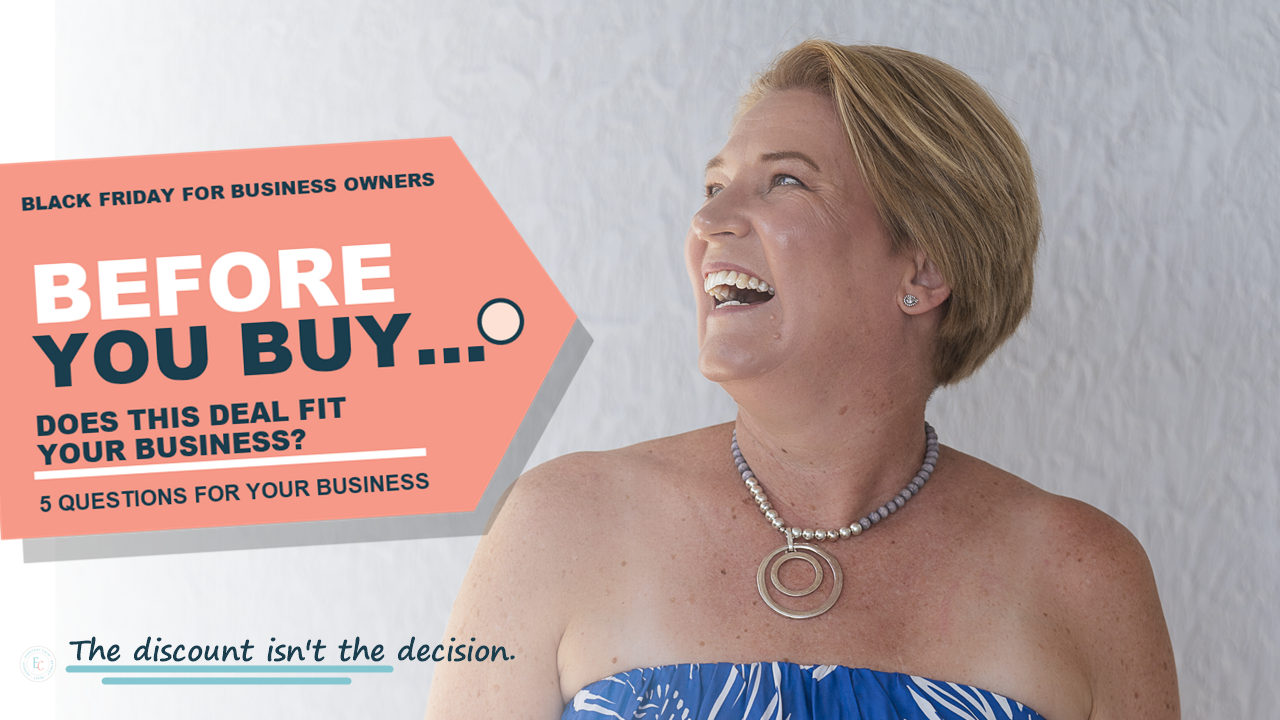
A Black Friday discount can be valuable, but the discount itself doesn't make something right for your business.
This is important because Black Friday doesn't wait until Black Friday anymore. The official date in Australia is 27 November this year, but the offers have already started appearing. Business Victoria says the sales seem to begin earlier every year.
Your inbox is going to fill with software subscriptions, courses, equipment and services promising their lowest price of the year. And some of them may be useful. Some might even be things you've considered buying before.
The real problem isn't Black Friday. The problem is that you're making a business decision from the size of the discount instead of what your business actually needs.
Before you click buy, I want you to pause long enough to ask: does this deal actually fit my business, my priorities and the money I have available?
A good discount and a good business decision are not the same thing
A lower price can make a purchase feel sensible even before you've decided whether the purchase itself is actually sensible.
That isn't that you've done something wrong. Black Friday offers are designed to get our attention. Countdown timers, limited places and large savings give us a reason to act quickly. Moneysmart warns that urgency, discounts and scarcity can lead to rushed or unplanned purchases.
But sometimes we need a reason to buy instead of continuing the back and forth procrastination.
A sale can still be worthwhile. If you already planned to purchase something your business needs, a genuine discount may help you spend less.
The difference is whether you're using the sale to support a decision you've made, or allowing the sale to make the decision for you.
Here are five questions that can help.
1. What job will this purchase do in your business?
Start with the problem, not the product.
What will this purchase help you do? Will it save time, improve delivery, replace an unreliable tool, support a planned project or help you build a capability your business needs now?
Try to describe its job in one very clear sentence.
For example:
- This software will replace the two systems I currently use to manage appointments and payments.
- This course will help me complete a project I've already committed to delivering.
- This equipment will replace something that's no longer reliable.
If the answer is vague, such as "it might help me grow", that doesn't automatically mean no. It does mean though that you need more information before making the decision.
A useful purchase has a clear role. Don't let it be another possibility to store for later.
2. Is it replacing something, or adding another cost?
A Black Friday purchase can look affordable on its own while becoming just one more monthly expense.
If it replaces something, write down what you'll cancel, sell or no longer need. If it's an addition, you need to be really honest about that too.
This is especially important with software. A discounted subscription can feel small on its own, but several small subscriptions can become a sizeable ongoing cost. The question isn't only, "Can I pay for this today?" It's also, "Do I want my business carrying this cost next year?"
Check what you already own before buying another tool, template or program. Sometimes the most useful next step is using what you have.
3. What is the full cost after the promotion ends?
The sale price may not be the full cost.
Check for:
- renewal prices
- monthly or annual subscription fees
- implementation or setup costs
- equipment, upgrades or add-ons required to use it
- time needed to learn or implement it
- cancellation terms
A $100 saving today doesn't automatically make sense if the purchase creates a cost your business will incur for years.
For larger or ongoing purchases, compare the promotional price with the normal total cost. Moneysmart also recommends considering ongoing costs and whether the purchase still fits your budget and goals after the initial sale.
4. Which business money will pay for it?
"There's money in the bank" isn't the same as "this money is available to spend".
Some of that bank balance may already have a job. It may need to cover GST, tax, wages, super, subscriptions, rent or the quieter weeks ahead (like the Christmas shutdown).
Ask:
- Which account or category will this purchase come from?
- Was there already money set aside for it?
- What known expenses are due before more money comes in?
- Will paying for it affect your ability to meet an existing commitment?
Business.gov.au recommends using a budget and regularly updated cash-flow statement to plan for future costs and seasonal quiet periods. You don't need a perfect forecast to make a better decision. You do need to look further ahead than today's bank balance.
If your business is profitable but the bank balance still feels tight, you may also find Why Your Business Is Profitable but There Is No Cash in the Bank useful.
5. What will this purchase leave less room for before the end of January?
Every yes uses money, time or attention that can't be used somewhere else.
That trade-off can be easy to miss in November. Christmas, summer shutdowns and slower January payments can change the timing of money coming into a business. A lot of businesses continue to carry most of their normal expenses even though income slows down.
Before buying, look at the period from now until the end of January.
What still needs to be paid? What income is reasonably expected? What happens if an invoice is late or January is quieter than hoped?
This question isn't designed to frighten you out of spending. It helps you see what the purchase is competing with so you can choose deliberately.
Buy it, plan for it or leave it
There are three perfectly valid answers to a Black Friday offer.
Buy it now
When it may fit: The purchase has a clear job, the full cost is understood and the money is available.
Useful next step: Record the purchase, implementation plan and any renewal date.
Plan for it later
When it may fit: The purchase may be useful, but the timing or available money isn't right.
Useful next step: Save the details and decide what needs to happen before you reconsider it.
Leave it
When it may fit: It duplicates something, has no clear job or creates a cost you don't want.
Useful next step: Close the tab and keep the money available for a priority that matters more.
Leaving a deal doesn't mean you have missed your only chance to improve the business. Buying something useful at the wrong time can create more pressure than progress.
What if you are running your own Black Friday sale?
I'm running a Black Friday offer this year too, so I'm not suggesting discounts are bad or that businesses shouldn't use them.
A genuine sale can make a valuable offer more accessible and give someone a clear moment to make a decision. But the offer still needs to make sense for the buyer and for the business delivering it.
If you're planning your own sale, check:
- Why are you running it?
- Is the saving genuine and described clearly?
- Can you deliver the offer well at the sale price?
- Have you allowed for the time and cost of delivery?
- Does the sale support the next step you want your business to take?
The ACCC says businesses must take care not to mislead customers about sale prices or savings. That includes making sure a higher comparison price is genuine and that conditions or exclusions are clear.
Your sale doesn't need pressure or inflated promises to work. It needs a clear offer, an honest reason to act and enough information for the right person to decide.
I want you to use this check on my offer too
Later this month, I'll open a Black Friday offer for Business Money Foundations.
I don't want you to join simply because it is discounted or because the doors are closing. I want you to understand what the six-week course helps you build, look at whether that's what your business needs, and make the decision from clearer numbers rather than pressure.
The deadline will be genuine. The saving will be genuine. But those facts alone don't make the course right for every business owner.
If your business-money decisions still depend on what happens to be in the bank today, or you keep trying to piece everything together alone, the first step is to make more of the picture visible.
That's what we'll begin during the four-day Making Money Method Challenge.
Join the four-day Making Money Method Challenge
The Making Money Method Challenge runs from 23 to 26 November 2026.
Across four days, I'll help you start looking at your business money with more clarity, build a more useful decision-making rhythm and see the gaps that keep creating uncertainty.
Register for the Making Money Method Challenge.
Come because you're ready to look at the numbers and take the next useful step. Not because a timer told you to.
This article provides general educational information only. It does not take into account your individual circumstances and is not personal financial or legal advice.